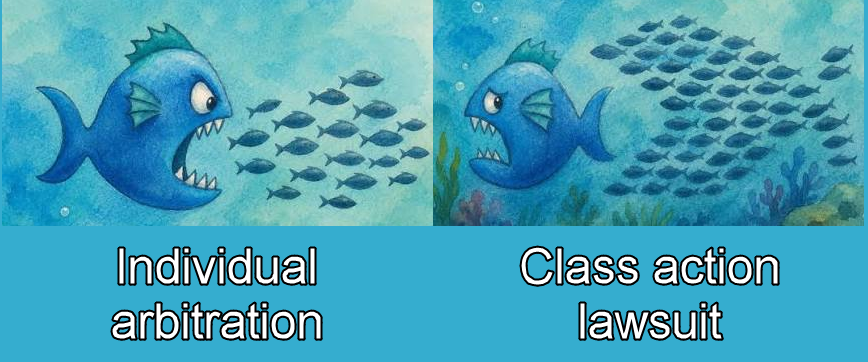
If a company violates its contractual obligations, causes injury or death, or sells a misleading product or service, then consumers deserve the right to sue the company in court, on the public record, and as part of a class action if necessary, as codified in the 7th amendment to the US Constitution, and rule 23 of the Federal Rules of Civil Procedure, respectively. Unfortunately, many companies are getting around this by introducing “arbitration agreements” and “class action waivers” to ensure they cannot be sued for wrongdoing.
Forced arbitration essentially says that disputes will not be settled in court, but by a private arbitration company, which is out of view of the public record.
The Federal Arbitration Act of 1925 is the legal basis for this behavior, but its scope has been expanded well beyond its original intention. The FAA was originally written to allow businesses to mutually agree to settle disputes via a private, third party arbiter (such as the American Arbitration Association), rather than going through the civil courts and having a jury trial. This was desirable because civil trials are expensive, time-consuming, and create bad blood between businesses who may want to work together in the future.
However, subsequent court rulings have removed the requirement for arbitration to be mutually agreed upon (Southland Corp. v. Keating, Marmet Health Care Center, Inc. v. Brown, Preston v. Ferrer), allowing large companies like Google and Microsoft to unilaterally force their users to agree to arbitration.
Many companies have been quietly adding “binding arbitration” to their terms of service, stripping away our right to a jury trial. Instead, they hire private arbitration companies to settle the dispute privately. The judge and jury are literally bought and paid for by the company who wronged you, and the record of the outcome isn’t even public. This is unacceptable in the United States.
Companies are doing this, not only to save a quick buck on court costs, but also to avoid setting legal precedent for when they screw up, so they can keep screwing up indefinitely. They are quietly and unilaterally taking away our rights.
Some notable examples include:
Disney, who argued that a man named Jeffrey Piccolo was not allowed to sue them for killing his wife in 2024 (their restaurant ignored her repeated allergen requests) on the grounds that he had agreed to the arbitration clause in the Disney Plus terms of service. After much public backlash, Disney decided to allow the lawsuit to proceed in court, but this was simply because Disney didn’t technically own the restaurant, so Disney believed they could win on the merits of the case. However, the fact that Disney could legally circumvent a jury trial for wrongful death is unconscionable, and it needs to be remedied IMMEDIATELY.
Roku, who had a massive data breach in March 2024, and then they updated their terms of service to include an arbitration agreement, preventing users from suing them. Shortly afterward, Roku had a second massive data breach in April 2024. Even if you owned an older Roku device that you bought years prior, with no ongoing Roku services, Roku forced you to agree to their new terms by remotely blanking out the screens of all Roku devices until their owners pressed the “agree” button. Ass covering at its finest.
These companies will sometimes claim that they allow users to opt out of these arbitration agreements and class action waivers. However, this is usually not true in practice for several reasons:
1. Users are often required to opt out by mailing a physical letter to the company, rather than an email or a simple “opt out” option on their account. Mailing a physical letter leaves me with no proof that I actually opted out, unless I remember to send the letter via certified mail with a return receipt. And let’s face it, businesses know that most users simply won’t bother mailing a physical letter at all because of the hassle, which is another reason why they often demand a physical letter to opt out.
2. Users are often only allowed to opt out of the CURRENT arbitration agreement, not of FUTURE arbitration agreements. This means a company can just continuously update their Terms of Service and bombard people with trap after trap until they getcha.
3. Users are often only allowed to opt out of retroactive application of the arbitration agreement, which is barely an improvement at all. If a company screws up in the future, you are forced into arbitration.
4. The option to opt-out is buried in the terms of service, where the companies know most people won’t notice it. These companies are doing the legal equivalent of roofying their users into signing away their rights.
These companies have the mentality of a rapist: they don’t want you to say no, so they make it extremely hard to say no. They’ll even force you to click “agree” by blanking out your TV screen. It is underhanded, unethical, and un-American. This practice needs to be banned.
Class action waivers are another provision in many terms of service, which unilaterally strip away customers’ right to file a lawsuit as a member of a group. This is often the best way to hold a large company accountable to its users, so of course companies are quietly forcing their users to waive this critical right.